Sold out. We can let you know when it is available.
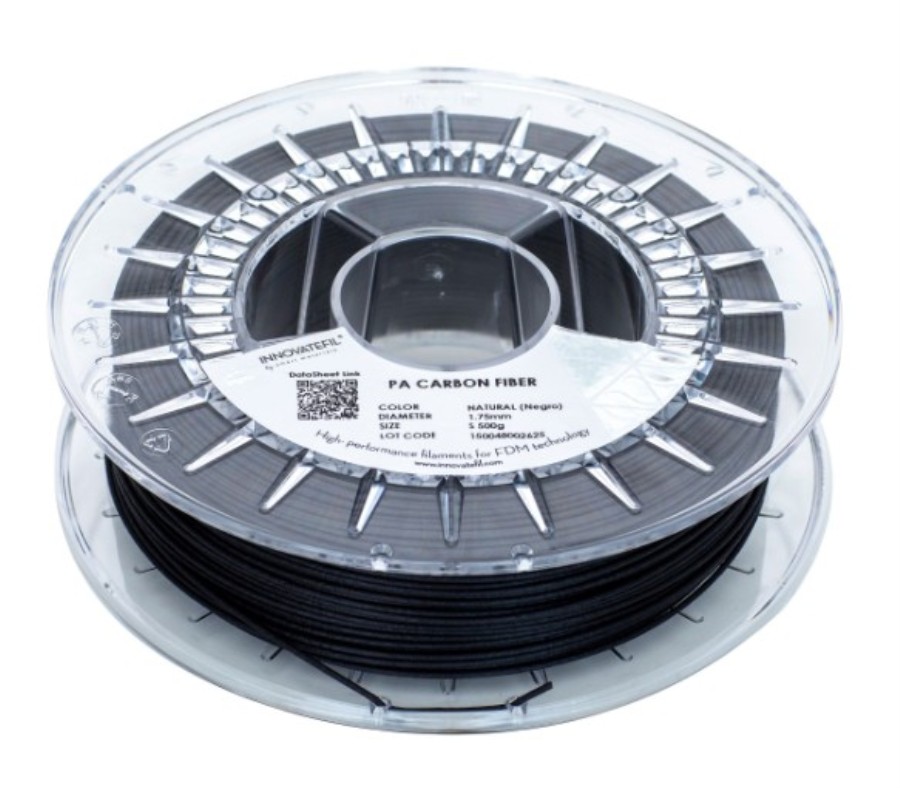
High-temperature polyamide technical filament reinforced with 15% carbon fibre, developed for 3D printing rigid, strong parts for functional and industrial applications. Smart Materials currently states a formulation of 85% polyamide and 15% carbon fibre.
The carbon fibre increases material stiffness and reduces the tendency to deform when printing large parts. The manufacturer targets the filament at end-use components and also states that the carbon fibre increases electrical conductivity, making the material potentially suitable for conductive or dissipative applications where the required performance has been verified for the design.
The material is abrasive. Smart Materials recommends a hardened-steel nozzle, or an equivalent wear-resistant nozzle, with a diameter of 0.6 mm or greater. A layer height of at least 0.2 mm is also recommended to reduce the risk of clogging and promote stable extrusion.
As starting settings, the technical data sheet specifies a printing temperature of 250–270 °C, a bed temperature of 60–90 °C, a print speed of 30–50 mm/s, layer cooling of 40–60% and material flow of 90–95%. These are reference settings and may require adjustment for the printer, geometry, nozzle and environmental conditions.
The published mechanical properties were measured on printed test specimens and show the anisotropy characteristic of the FFF/FDM process: tensile strength is 78.3 MPa in the XY plane and 23.7 MPa in the XZ plane. The manufacturer states that actual values depend on design and printing conditions and should not be used directly as design or quality-control values.
Polyamides can absorb moisture. Current manufacturer information states that the material is supplied protected against moisture and recommends keeping it in a dry, dark environment and drying it before printing when necessary. Absorbed moisture can generate vapour during extrusion and impair the surface finish.
After printing, excess material should be removed from the nozzle to reduce the risk of blockage. When different materials are alternated, the manufacturer recommends suitable extruder cleaning and notes that dedicating a nozzle to each material can help prevent unwanted contamination or mixing.
| Product type | Technical filament for FFF/FDM 3D printing |
| Material | High-temperature polyamide reinforced with carbon fibre |
| Stated composition | 85% polyamide + 15% carbon fibre |
| Colour | Black (True Black) |
| Filament diameter | 1.75 mm |
| Net weight | 750 g |
| Density | 1.25 g/cm³ |
| Density standard | ISO 1183 |
| Printing temperature | 250–270 °C |
| Bed temperature | 60–90 °C |
| Print speed | 30–50 mm/s |
| Layer cooling fan | 40–60% |
| Material flow | 90–95% |
| Recommended layer height | ≥ 0.2 mm |
| Recommended nozzle | ≥ 0.6 mm, hardened steel or equivalent wear-resistant material |
| Abrasive material | Yes; due to carbon-fibre reinforcement |
| Tensile strength, XY plane | 78.3 MPa, ISO 527 |
| Tensile strength, XZ plane | 23.7 MPa, ISO 527 |
| Flexural strength, XY plane | 133.2 MPa, ISO 178 |
| Flexural modulus, XY plane | 4863.8 MPa, ISO 178 |
| Elongation at maximum stress, XY plane | 1.5%, ISO 527 |
| Elongation at maximum stress, XZ plane | 1.2%, ISO 527 |
| Tensile elongation at break, XY plane | 1.7%, ISO 527 |
| Tensile elongation at break, XZ plane | 1.4%, ISO 527 |
| Flexural elongation at break, XY plane | 5.2%, ISO 178 |
| Glass transition temperature (Tg) | 65 °C, ISO 11357 |
| Vicat B | 65 °C at 50 N and 50 °C/h, ISO 306 |
| HDT B | 56 °C at 0.45 MPa, ISO 75 |
| Published mechanical-specimen conditions | 0.4 mm nozzle, 100% rectilinear infill and 0.2 mm layer height |
| Recommended storage | Dry, dark environment; protect from moisture |
| Pre-drying | Recommended by the manufacturer before printing when required; no drying temperature or time is stated on the current page |
| Electrical conductivity | Carbon fibre increases conductivity; the manufacturer does not publish a quantitative resistivity/conductivity value |