 Sold out. We can let you know when it is available.
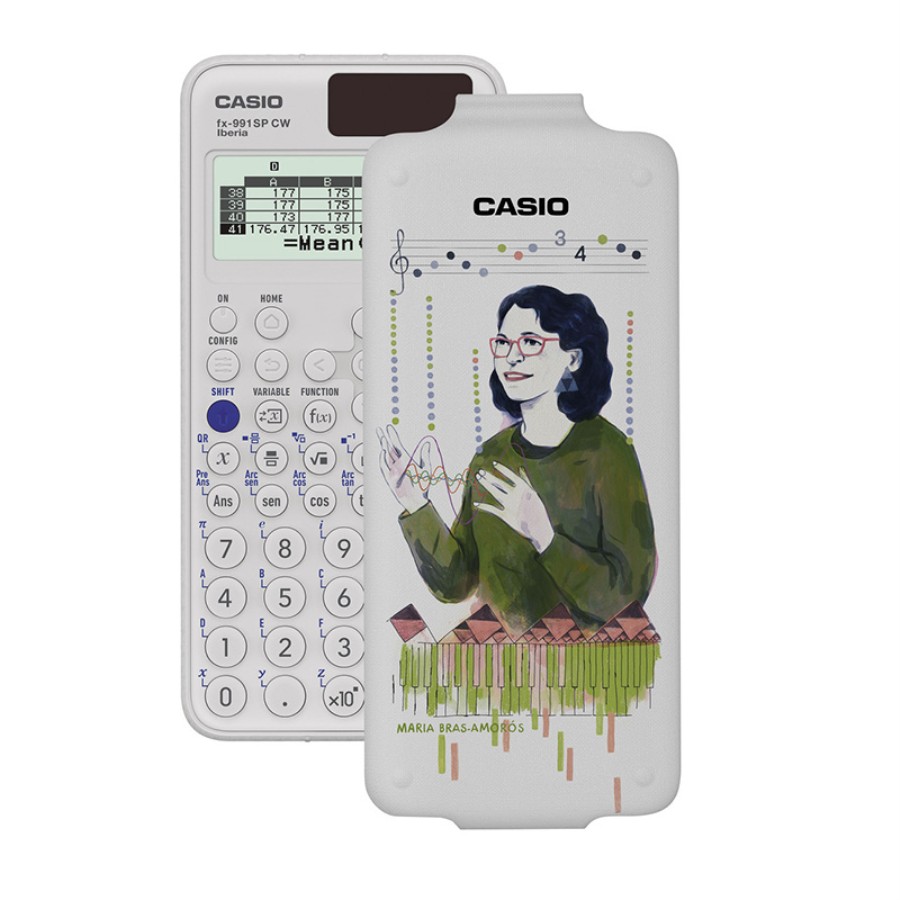
María Bras-Amorós grew up in a family where scientific interest was always strong. Her father and grandparents were engineers, and her father taught her to program when she was just a child. From a young age, she loved mathematics and music, and over time she found a way to combine these two disciplines.
María decided to study mathematics thanks to the enthusiasm for the subject instilled by Pilar Alcón, her mathematics teacher in her final year of high school (COU). In 1998, after completing her degree in Applied Mathematics at the Polytechnic University of Catalonia (UPC), she pursued her doctorate between San Diego State University and the UPC thanks to a predoctoral fellowship. A year later, she completed her professional degree in clarinet at the Barcelona Municipal Conservatory of Music.
Currently, Bras-Amorós works in two different fields. One of these areas is error-correcting coding theory, and the other is numerical semigroups, a field that combines algebra with combinatorics. In addition to her research, Bras-Amorós has also dedicated herself to popularizing mathematics through books and exhibitions. In 2014, she curated the exhibition "Matemàtiques en Joc" (Mathematics at Play) at the Museu del Joguet de Catalunya (Toy Museum of Catalonia) in Figueres, and in 2017, she published "Els números canten. Cançons i cantarelles de nombres" (Numbers Sing: Songs and Chants of Numbers) with Toni Giménez Fajardo.
Maria Bras-Amorós has always been fascinated by the connections between music and mathematics. Mathematics can be used to formalize elements of music theory, such as musical harmonics or the subdivision of rhythm. Music, in her case, has also informed mathematical results. She says that some properties of music she had perceived since childhood, she later interpreted as a fractal behavior of harmonics. She didn't use that word back then, but she could see it, and it was a great pleasure for her to be able to use it in her mathematical proofs.
As a child, her father never answered her math questions, which puzzled her. Today she remembers it fondly and has come to understand why her father always told her, "Think." He did it so she would arrive at the answer on her own. Now she appreciates it. "There's no need to rush; it's better to stop and think, even if we're not going very fast, because what you've thought will stay with you forever."