Available
The SIM800L V2.0 is a cellular communications module based on the SIMCom SIM800L modem. It adds GSM/GPRS connectivity to microcontrollers and other embedded systems for sending and receiving SMS messages and transferring low-rate data.
The module operates on four GSM bands: GSM 850, EGSM 900, DCS 1800 and PCS 1900 MHz. The term quad-band refers to these four radio bands within the same GSM/GPRS technology, not to four mobile network generations. It is intended for second-generation GSM/GPRS networks and does not support 3G, 4G/LTE or 5G. The SIM800L does not provide Bluetooth connectivity.
Operation requires an active micro-SIM and GSM/GPRS coverage on at least one of the supported bands. The availability of 2G service depends on the network operator and the location in which the module is used.
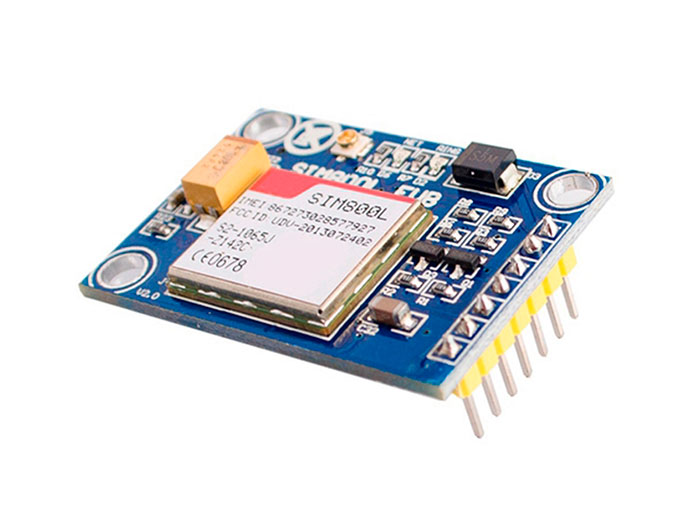
The host communicates with the board through a TTL-level UART and AT commands. The board provides 5V, GND, VDD, SIM_TXD, SIM_RXD, a second GND terminal and RST connections. The 5V terminal supplies the board, while VDD is used for UART logic-level matching. The board documentation states compatibility with 2.85 V, 3.3 V and 5 V controllers. TX and RX must be cross-connected, and the board and host must share a common ground.
The board requires a 4.6–5.2 V DC supply, with a nominal value of 5 V. The board documentation calls for a supply rated at no less than 1 A. The voltage must also remain stable during transmission bursts, when the modem may produce current peaks of up to 2 A. Short power leads with a suitable conductor size are recommended to reduce voltage drops and prevent unexpected resets.
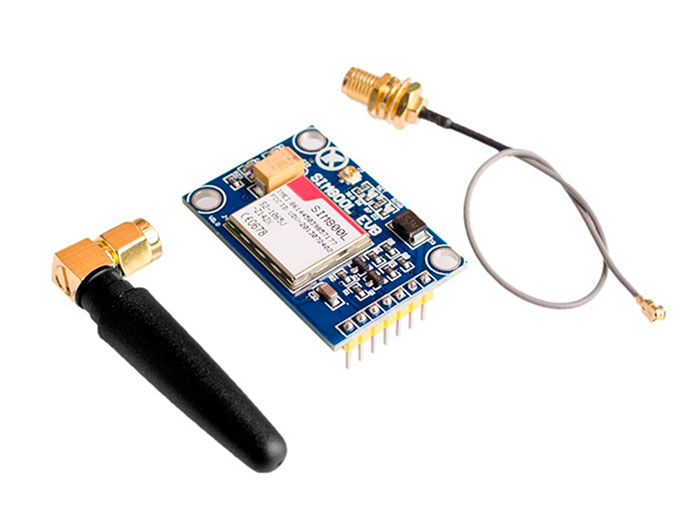
The board includes a micro-SIM holder, NET and RING indicators and an RST reset input. It is supplied with an external GSM antenna with an SMA connection and an adaptor lead. The board measures 27 × 39 mm.
Typical applications include telemetry, alarms, SMS notifications and control, and low-rate remote data transfer. Before selecting the module, confirm that the intended network operator continues to provide compatible GSM/GPRS service at the installation location.
| Electrónica Embajadores reference | LCGS004 |
| Model | SIM800L V2.0 |
| Type | GSM/GPRS cellular communications module |
| Integrated modem | SIMCom SIM800L |
| Cellular technology | GSM/GPRS for 2G networks |
| Band configuration | Quad-band |
| Frequency bands | GSM 850, EGSM 900, DCS 1800 and PCS 1900 MHz |
| GSM standard | GSM Phase 2/2+ |
| Mobile network compatibility | GSM/GPRS; no 3G, 4G/LTE or 5G support |
| Bluetooth | Not supported |
| GPRS configuration | Multi-slot Class 12 by default; Class 10 optional; mobile station Class B |
| Maximum GPRS data rate | Up to 85.6 kbit/s downlink or uplink, depending on the multi-slot configuration |
| GPRS coding schemes | CS-1, CS-2, CS-3 and CS-4 |
| Transmit power | Class 4: 2 W on GSM 850 and EGSM 900; Class 1: 1 W on DCS 1800 and PCS 1900 |
| SMS messaging | MO, MT and cell broadcast —CB—; text and PDU modes |
| Data services | GPRS, CSD up to 14.4 kbit/s, USSD, PPP and an integrated TCP/IP stack |
| Control | AT commands conforming to 3GPP TS 27.005, 3GPP TS 27.007 and ITU-T V.25ter, plus SIMCom extensions |
| Host interface | TTL-level UART |
| UART data rates | Fixed: 1 200, 2 400, 4 800, 9 600, 19 200, 38 400, 57 600 and 115 200 bit/s; automatic detection: 1 200–57 600 bit/s, enabled by default |
| Serial configuration | 8 data bits, no parity and 1 stop bit —8N1— |
| UART logic-level compatibility | 2.85 V, 3.3 V and 5 V controllers through the VDD level-matching terminal |
| Board supply voltage | 4.6–5.2 V DC —5 V nominal— |
| Power-supply requirements | At least 1 A according to the board documentation; the supply must hold its voltage during modem transmission peaks of up to 2 A |
| SIM card | micro-SIM; 1.8 V or 3 V interface |
| Indicators | NET LED and RING LED |
| Connections | 5V, GND, VDD, SIM_TXD, SIM_RXD, GND and RST |
| Included antenna | External GSM antenna with SMA connection and adaptor lead |
| Operating temperature | −40 to +85 °C |
| Board dimensions | 27 × 39 mm |