 Sold out. We can let you know when it is available.
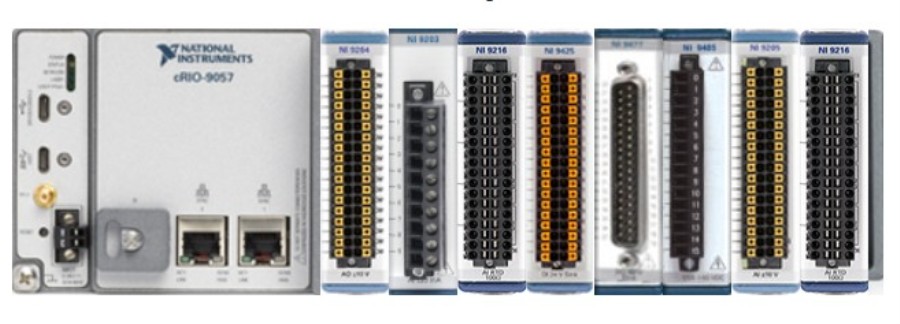
The NI CompactRIO cRIO-9057 assembly, identified by configuration CR7189265, combines a real-time controller, eight C Series input/output modules and connection and mounting accessories. It is a programmable platform for acquiring electrical signals and implementing monitoring and control functions. All eight slots are occupied by the supplied configuration; adding further modules requires a change to the system architecture.
The processor runs applications on NI Linux Real-Time, while the Artix-7 field-programmable gate array (FPGA) enables acquisition and control logic to be implemented in hardware. The controller supports Real-Time with NI-DAQmx, Real-Time Scan and LabVIEW FPGA modes. The selected mode, device driver versions and application development determine actual performance; supplying the hardware does not mean that a programmed control application is included.
The NI 9203 accepts eight current signals, while the NI 9205 provides either 32 single-ended or 16 differential voltage inputs. Their maximum sampling rates are aggregate figures for each module, shared between the acquired channels. They are not independent maximum rates for every input and do not imply simultaneous sampling of all signals.
The two NI 9216 modules provide 16 inputs for three- or four-wire Pt100 platinum resistance temperature detectors (RTDs), with built-in excitation. Each module allows a choice between faster acquisition and greater rejection of mains interference. High-speed mode scans eight channels in 20 ms; high-resolution mode takes 1.6 s for the same scan. Probe selection, wiring and calibration are part of the measurement chain and cannot be replaced by the converter’s 24-bit resolution.
The intended use concerns the installation being monitored, not the computer’s operating temperature. The cRIO-9057 operates at an ambient temperature of −20 °C to 55 °C. The published NI 9216 temperature measurement range is −200 °C to 850 °C. This assembly must not be represented as capable of measuring below −200 °C or as suitable for placing the electronics in a cryogenic environment.
The NI 9264 provides 16 analogue voltage outputs, each with its own digital-to-analogue converter. These serve as setpoint or excitation signals within the module’s electrical limits, rather than power outputs for heaters or other high-current loads. The NI 9425 has 32 sinking digital inputs, which receive current from sourcing output devices; the NI 9477 switches 32 sinking digital outputs, completing the current path to common and requiring an appropriate external load supply.
The NI 9485 adds eight normally open solid-state relays. Switching voltage is limited to 60 V DC or 30 V RMS, so it is not a module for directly switching 230 V mains. Permissible current and switching rate must be assessed together with the load and duty cycle.
The controller has two Gigabit Ethernet ports with network synchronisation features, two USB-C interfaces with different roles, and a microSD slot. The supplied kit enables DIN rail mounting. Installation must comply with the manufacturer’s ventilation, earthing and environmental requirements. Shock and vibration specifications that require panel mounting must not be applied to DIN rail mounting without verification.
The NI 9477 has no short-circuit or reverse-voltage protection and may produce 3 ms to 4 ms output transients when the chassis is powered or reset. The NI 9264 also produces power-on and power-off transients. Protection and safe actuator states must therefore be designed into the installation; this supply does not replace any independent safety mechanisms it requires.
The electronics require an external 9 V DC to 30 V DC supply; NI recommends 24 V DC, 60 W. The specified maximum power at the controller input is 30 W under NI’s defined loading conditions and is not the power available to field actuators. The installation must include a suitably rated, accessible and labelled switch or circuit breaker to disconnect the system from the DC supply. Each module’s calibration interval must be observed to maintain its metrological performance.
The assembly comprises only the hardware and accessories detailed in this sheet. The quotation does not list an external power supply, Pt100 probes, process sensors, field wiring, an enclosure, development licences or a dedicated control application. Integration, programming and functional validation of the installation are additional tasks. The two supplied NI 9940 backshells do not provide an individual cover for each of the five modules fitted with a 36-position spring-terminal connector.