Sold out. We can let you know when it is available.
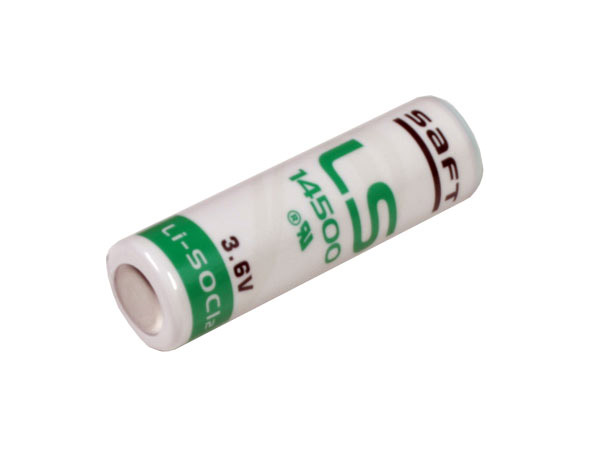
The Saft LS14500 is a non-rechargeable primary lithium-thionyl chloride (Li-SOCl₂) cell with a nominal voltage of 3.6 V in an AA format. Its bobbin construction is intended for long-duration applications using low base currents with periodic current demands.
Nominal capacity is 2.6 Ah, determined at a 2 mA discharge rate at 20 °C down to a 2.0 V cut-off voltage. The capacity actually available depends on discharge current, temperature, cut-off voltage and cell orientation, so the nominal figure should not be interpreted independently of these conditions.
The maximum recommended continuous current is 50 mA. The cell provides pulse capability of up to 250 mA under the test conditions specified by Saft: 0.1 s pulses every 2 min at 20 °C for 24 h with a 10 µA base current. Pulse response depends on pulse duration and frequency, temperature and the previous history of the cell; under severe conditions or with high pulse currents, the manufacturer may recommend using a supporting capacitor.
The LS14500 reference denotes the standard cell without a termination suffix. Saft uses specific suffixes for variants fitted with tabs, pins, axial leads or flying leads; for example, the CNA suffix identifies the version with axial leads.
The cell can operate from −60 °C to 85 °C and has a self-discharge rate of less than 1 % per year when stored at 20 °C after the first year. Saft recommends storage in a clean, dry and ventilated area, preferably at no more than 30 °C.
Typical applications:
Safety: this is a non-rechargeable cell. Incorrect use presents a risk of fire, explosion and severe burns. Do not recharge, short-circuit, crush, disassemble, heat above 100 °C, incinerate or expose the contents to water. Do not solder directly to the cell; where a soldered connection is required, use a version with an appropriate termination. Do not mix new and used cells or cells from different origins, and always observe the correct polarity.
| Brand | Saft |
| Model | LS14500 |
| Series | LS 14500 |
| Type | Non-rechargeable primary lithium cell |
| Technology | Lithium-thionyl chloride (Li-SOCl₂) |
| Construction | Bobbin |
| Size | AA |
| Termination | Standard cell, no termination suffix |
| Nominal voltage | 3.6 V at 0.2 mA and 20 °C |
| Open-circuit voltage | 3.67 V at 20 °C |
| Nominal capacity | 2.6 Ah at 2 mA and 20 °C, down to a 2.0 V cut-off voltage |
| Nominal energy | 9.36 Wh |
| Maximum recommended continuous current | 50 mA |
| Typical pulse capability | Up to 250 mA; 0.1 s pulses every 2 min at 20 °C for 24 h with a 10 µA base current |
| Self-discharge | < 1 % per year when stored at 20 °C, after the first year |
| Operating temperature | −60–85 °C |
| Maximum recommended storage temperature | 30 °C |
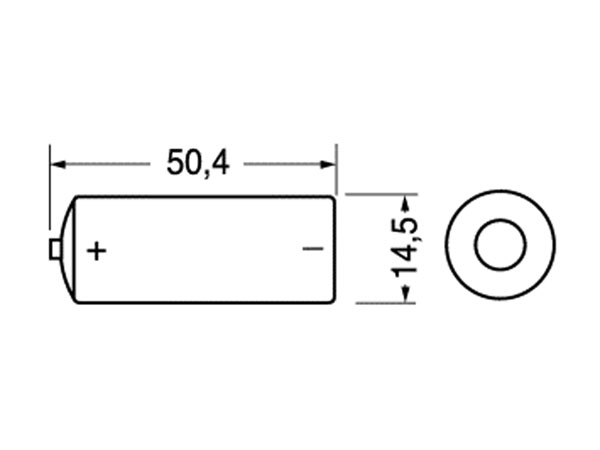
| Maximum sleeved-cell diameter | 14.62 mm |
| Maximum sleeved-cell height | 50.28 mm |
| Typical weight | 17 g |
| Lithium metal content | Approximately 0.7 g |
| Container material | Stainless steel |
| Seal | Hermetic glass-to-metal |
| Electrolyte | Non-flammable |
| Safety standards | UL 1642; IEC 60086-4; IEC 60079-11 section 10.5, T4 rating at 60 °C |
| Transport | UN 3090; UN 3091 |
| Environmental compliance | RoHS; REACH |