 Available
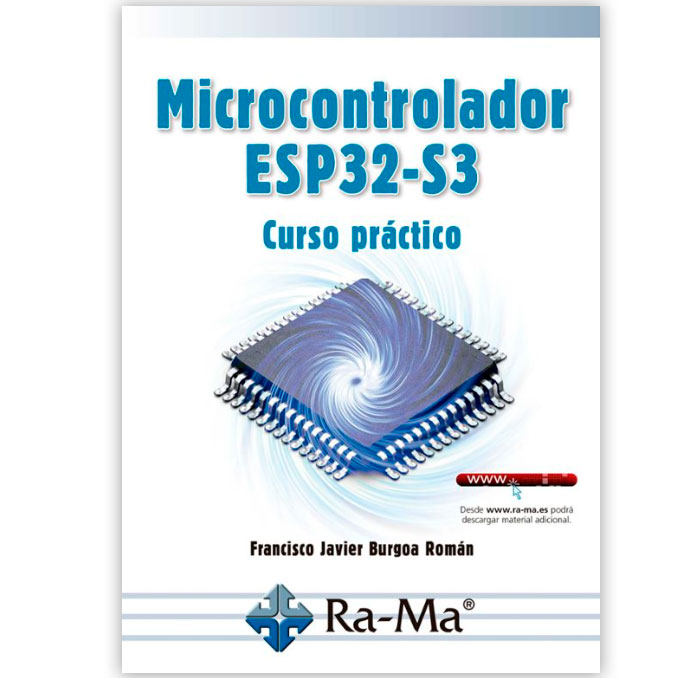
Microcontrolador ESP32-S3. Curso práctico is a Spanish-language technical book for learning how to program the ESP32-S3 through activities that combine electronics and software development. It uses ESP-IDF, Espressif’s official development kit, together with Visual Studio Code, allowing readers to study peripheral configuration, memory management, debugging and real-time application development in greater depth.
The content may be particularly useful for readers who have already worked with Arduino and wish to move to an environment that provides more direct control over the hardware. The learning path progresses from setting up the development environment and using the microcontroller’s basic resources to communications, structured embedded programming and FreeRTOS.
The book is intended for students, lecturers, enthusiasts and people interested in embedded-systems development. Basic knowledge of electronics and the C programming language is recommended, but previous experience with ESP-IDF or real-time operating systems is not required. The examples draw on laboratory, teaching and professional-development situations in which the hardware and software must operate together.
The book contains more than 30 working examples and exercises intended to consolidate the concepts covered. The examples have been tested on the ESP32-S3 DevKitC-1 development board. A solderless breadboard, LEDs, resistors and a potentiometer are recommended for the initial practical activities. Additional supporting files can also be downloaded from the publisher’s book page.
The introduction also considers the use of generative artificial intelligence tools to assist with repetitive work, auxiliary-function generation, debugging and the exploration of design alternatives. These tools are presented as occasional support rather than a replacement for engineering judgement, system design or developer responsibility.
Scope and limitations: the book concentrates on the peripherals and techniques needed to establish a practical foundation in ESP32-S3 development, rather than attempting to document every feature of the microcontroller. It does not cover vector motor control, IoT or IIoT architectures, cloud services or comprehensive connected-device security in depth. It also notes that power consumption must be considered when selecting the platform for battery-powered equipment.
| Product type | Technical book |
| Title | Microcontrolador ESP32-S3. Curso práctico |
| Author | Francisco Javier Burgoa Román |
| Publisher | RA-MA |
| Collection | Electrónica/Robótica |
| Subject | Embedded systems and microcontrollers |
| Edition | 1st edition |
| Publication date | 6 February 2026 |
| Book language | Spanish |
| Format | Print edition |
| ISBN | 979-13-88059-28-5 |
| EAN | 9791388059285 |
| Legal deposit | M-1398-2026 |
| Number of pages | 278 |
| Dimensions | 17 × 24 cm |
| Weight | 479 g |
| Target readership | Students, lecturers, enthusiasts and people interested in embedded-systems development |
| Recommended prior knowledge | Basic electronics and C programming; advanced knowledge is not required |
| Microcontroller covered | ESP32-S3 |
| Development kit used | ESP-IDF |
| Development environment | Visual Studio Code |
| Board used for the examples | ESP32-S3 DevKitC-1 |
| Debugging methods | Serial terminal and JTAG |
| Content structure | Programming environment, peripherals, communications, good embedded-programming practices and FreeRTOS |
| Peripherals and resources covered | GPIO, ADC, DMA, timers, PWM, pulse counters, watchdog timers, sleep modes, the WS2812B LED, the internal temperature sensor, sigma-delta modulation, memory, SPIFFS, non-volatile storage and digital-to-analogue conversion |
| Communications covered | UART, native USB, I²C, IEEE 802.11 b/g/n Wi-Fi and Bluetooth |
| Communications applications | HTTPS client, web server, UDP server and simple mobile applications |
| Real-time operating system | FreeRTOS |
| FreeRTOS content | Tasks, queues, mutexes, semaphores, scheduling, priorities, statistics, events, memory management, starvation, deadlock and priority inversion |
| Practical examples | More than 30 working examples |
| Exercises | Consolidation exercises in the main practical chapters |
| Recommended equipment for initial practical work | Solderless breadboard, LEDs, resistors and potentiometer |
| Additional material | Downloadable files available from the book’s page on the RA-MA website |
| DAC note | The ESP32-S3 has no internal DAC; the book includes a chapter on digital-to-analogue conversion |
| Scope limitations | Does not cover vector motor control, IoT, IIoT, cloud services or comprehensive connected-device security in depth |